





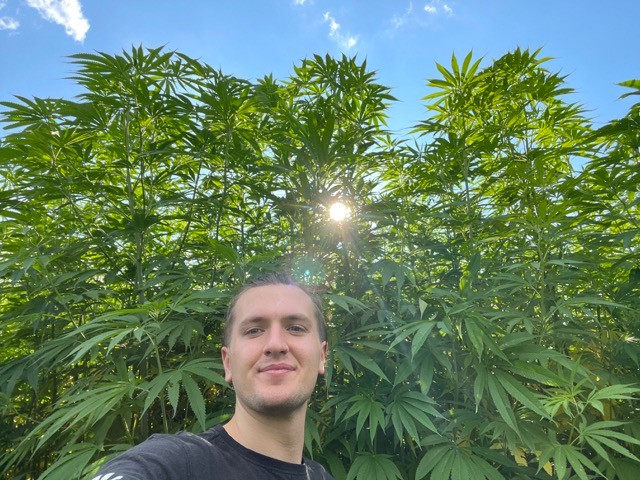
Today we’d like to introduce you to Cody Ley.
Alright, so thank you so much for sharing your story and insight with our readers. To kick things off, can you tell us a bit about how you got started?
My journey into the hemp industry began back in 2018 as an undergraduate studying bio-based plastics. Quickly I was amazed by the versatility of this plant and what it also does for the environment. That’s when the idea of Hemp 4 Humanity was born. I called my childhood best friend Tyler and told him I wanted to build sustainable communities out of locally grown hemp. He was down with the mission as always.
So, once I finished school in 2020, I started the business, and we planted our first hemp field in late May of 2021. At this time the infrastructure for industrial hemp (fiber and grain) was extremely underdeveloped. So, there wasn’t much of a path for us to grow hemp to make into our building materials for these homes. With that being the case, we decided to grow a high CBG flower variety. This was perfect for me because my background is in sinsemilla hemp cultivation and extraction. So, my main goals for that first year were to establish our farm, prove the farm-to-consumer business model, and lay a financial foundation for us to expand into building material production. The results of that year is a product called CBGenius. An organic, all-natural energy supplement that is grown, extracted, formulated, and manufactured all by H4H here in Michigan. After we got that product to market, we were able to finally begin our industrial hemp endeavors.
The next planting season, we planted 2 different fiber/grain varieties and 3 different densities to find what style is the best for production of hemp building materials like hemp lime. That was a fun summer full of learning, I was able to watch my plants grow while also traveling the country, visiting other farmers, processing facilities, and most importantly hemp building training courses. I saw hemp builds going up from Washington to Pennsylvania and I was fortunate enough to become US Hemp Building Association’s Regional Leader for the mid-west. With these resources, I was able to finally visualize how I can achieve my goal of building sustainable communities out of this plant. I also realized that in doing so, I have the opportunity to build a lot more than just houses with this plant.
Building with hemp will allow us to, in the same breath, build soil health, build resilient local economies, and most importantly, build true community. It’s not about just empowering people with food shelter and energy but actually giving people the tools they need to empower themselves with food, shelter, and energy all from a local sources. We aren’t just building houses; we are allowing a community to rebuild itself from the soil up. This vision has materialized as the current project we are working towards called Renewabuild Detroit. This is a multi-organization effort to provide affordable housing to low-income families in blighted areas of Detroit. With this development, we will be able to measure the true impact of growing hemp for emerging bio-material manufacturing industries. By true impact, I mean not just the balance sheet but also the environmental and social impact as well. We are setting up a supply chain to take hemp from local small farmers and produce nontoxic healthy homes that are carbon-negative and highly energy efficient. Hemp can show us a glimpse into what a circular regenerative economy could look like. Where the waste products of sustainable agricultural food production can be used as feedstock for an infinitely recyclable consumer goods economy.
We all face challenges, but looking back, would you describe it as a relatively smooth road?
Of course, we have faced challenges. The hemp industry is very new here in North America. This means the infrastructure and supply chain (decortication, secondary manufacturing, end product retail markets) were nonexistent. We are building a business while building an industry which offers challenges, but we are trying to build it from the farm up in a sustainable way.
The laws and regulations around hemp are very heavy because the federal government still outlaws THC. This leaves a lot of hemp businesses at the discretion of very cautious state governments and financial institutions. For example, we are still in battle with payment processors on our website for direct-to-consumer sales of CBGenius. We are struggling to run ads or keep our social media accounts active because they are deathly afraid that we are selling illegal drugs, I guess. Also, on the farm side of things, this year we had an extra $1,000 of expenses due to a test result coming back at 0.57% THC in which we had to grind up and retest in order to make sure our hemp was compliant. Even though it’s going into a wall system…
Large-scale outdoor farming was a huge learning curve. It doesn’t matter how familiar you are with what your plant needs, once you bring it outside at scale, you are answering to an entirely different boss. That’s the soil and the elements. So, learning how to farm and farm in a way that’s not exploitative to the environment was challenging and ongoing as I’m sure it always will be.
Building and Construction is also a difficult industry to penetrate but with the work of the USHBA getting hemp into the IRC codes this year that has been a huge step in the right direction. Despite these challenges, I am very optimistic because the obstacles shrink in comparison to where the industry could take us.
Can you tell our readers more about what you do and what you think sets you apart from others?
First and foremost, I am a cultivator. I have been growing this plant for 7+ years and it’s where a lot of my passion is.
I also have experience in oil processing, as I mentioned before. I’ve built out a large-scale CO2 extraction facility and am very familiar with the chemistry and product formulation side of the hemp/cannabis oil industry. In school, I studied Biochemistry and Environmental Science which gave me a good background to do so.
And most recently, I have become very well-versed in the science of building with hemp. After training in hemp building this past year, joining the USHBA, and participating in builds around the country, I have been able to present a lot of my findings at my own workshops and speaking engagements all around Michigan. I look forward to getting a winter event schedule out here soon as well. But in terms of natural building techniques, I would still consider myself a beginner. I know hemp very well, but I am burning to learn more on regenerative architecture and natural material buildings.
What matters most to you? Why?
Connecting with people and also better understanding our relationship to the natural environment. Because I believe that the health of a system is the health of an individual unit and vice versa. But sometimes, we tend to forget that our natural environment is in our “system” as well. But that’s what I think of when I think about anything, business or buildings. They should be approached with regard to the bigger picture.
Contact Info:
- Website: h4h.earth
- Instagram: https://www.instagram.com/h4h.earth/
- Facebook: https://www.facebook.com/Hemp-4-Humanity-102632682451574